Expression Beyond On/Off Keys
Traditional digital keys often reduce a performance to note start, note end, and estimated velocity. Continuous position sensing opens the door to richer control while the key is moving, held, and released.
A custom piano key assembly concept that combines mechanical product design, sensor strategy, firmware thinking, and musical interaction design for more expressive digital instruments.
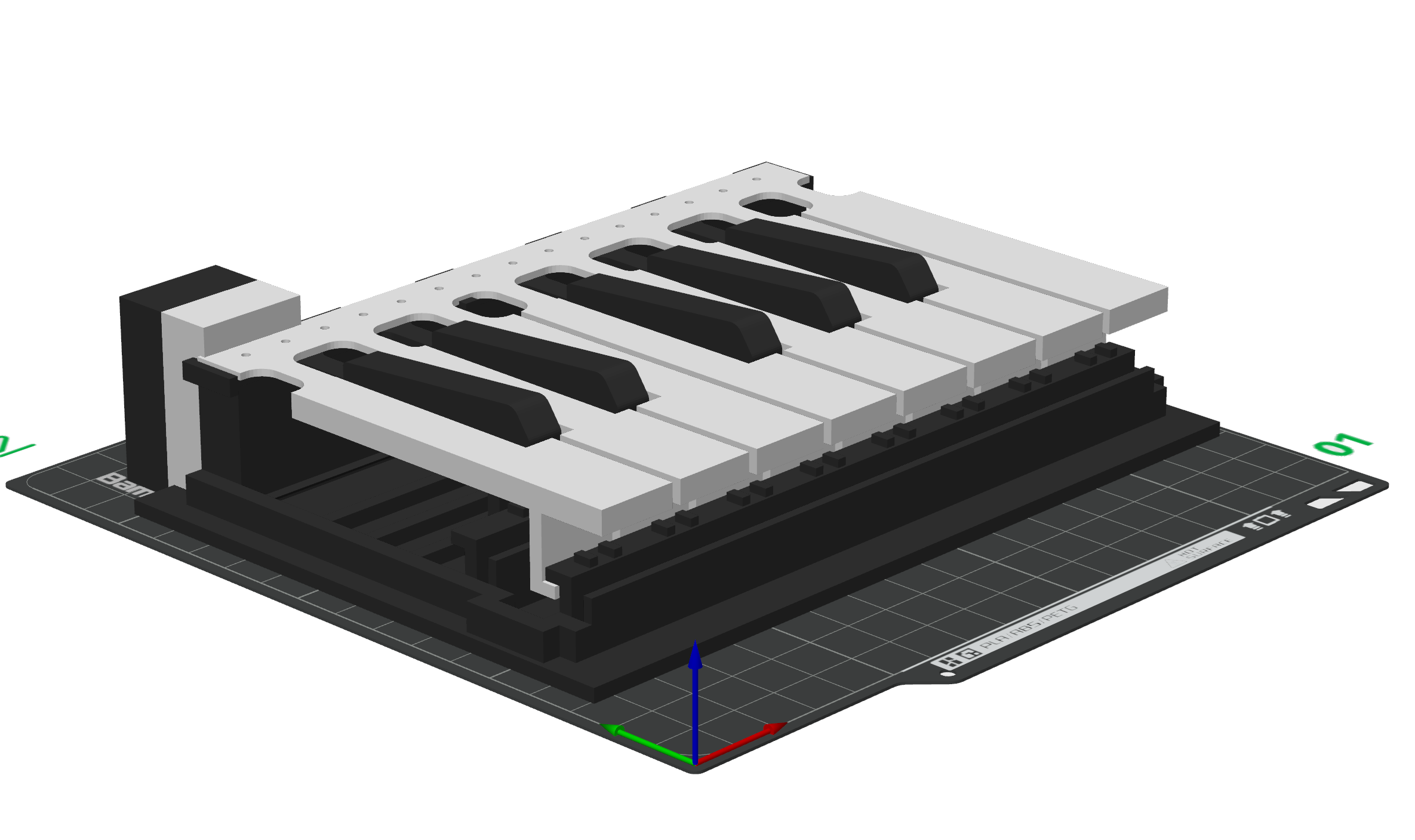
Expressive music hardware is a full product problem. The mechanical feel, sensing method, firmware behavior, calibration workflow, and sound engine all shape what the player can actually express. This prototype shows how robisonic can explore those decisions early, when changes are still fast and affordable.
Traditional digital keys often reduce a performance to note start, note end, and estimated velocity. Continuous position sensing opens the door to richer control while the key is moving, held, and released.
A linear Hall sensor reads changes in a magnetic field as the key moves. That can provide contactless, continuous position data, which is useful for nuanced dynamics, aftertouch-style control, calibration, and custom response curves.
The value is not only the mechanical model. The key geometry, sensor placement, firmware interpretation, calibration, and audio response all need to work as one product system.
A detailed 3D prototype lets teams evaluate feel, assembly constraints, sensor strategy, electronics placement, and industrial design direction before expensive manufacturing decisions lock in.
Not just pressed or released.
With a small magnet and a linear Hall sensor, the instrument can read the key's position through its travel. That gives the firmware more than a trigger event: it can shape velocity, pressure-like expression, release behavior, modulation, and per-key response in a way that feels closer to a living instrument.
This kind of work is useful when a product needs a physical control surface that feels intentional, captures nuance, and connects cleanly to the software or sound engine behind it.
We can help explore the mechanical concept, sensing approach, embedded firmware, calibration workflow, MIDI or control mapping, and audio response that turn a hardware idea into a playable product experience.
Talk about hardware prototypingHave a music product, embedded device, browser tool, AI audio workflow, or specialized software system in mind? Send the rough idea and we will help map the path from technical risk to shippable product.
Tell us what needs to sound, sense, or ship.